To Hale Sisters


DETROIT,
12th March, 1894.
DEAR SISTERS,

I am now living with Mr. Palmer. He is a very nice gentleman. He gave a dinner the night before last to a group of his old friends, each more than 60 years of age, which he calls his “old boys’ club”. I spoke at an opera house for two hours and a half. People were very much pleased. I am going to Boston and New York. I will get here sufficient to cover my expenses there. I have forgotten the addresses of both Flagg and Prof. Wright. I am not going to lecture in Michigan, Mr. Holden tried to persuade me this morning to lecture in Michigan but I am quite bent upon seeing a little of Boston and New York. To tell you the truth, the more I am getting popularity and facility in speaking, the more I am getting fed up. My last address was the best I ever delivered. Mr. Palmer was in ecstasies and the audience remained almost spellbound, so much so that it was after the lecture that I found I had spoken so long. A speaker always feels the uneasiness or inattention of the audience. Lord save me from such nonsense, I am fed up. I would take rest in Boston or New York if the Lord permits. My love to you all. May you ever be happy!

Your affectionate brother,

VIVEKANANDA

To the Hale Sisters


DETROIT,
15th March, 1894.
DEAR BABIES,
I am pulling on well with old Palmer. He is a very jolly, good old man. I got only 127 dollars by my last lecture. I am going to speak again in Detroit on Monday. Your mother asked me to write to a lady in Lynn. I have never seen her. Is it etiquette to write without any introduction? Please post me a little letter about this lady. Where is Lynn? The funniest thing said about me here was in one of the papers which said, “The cyclonic Hindu has come and is a guest with Mr. Palmer. Mr. Palmer has become a Hindu and is going to India; only he insists that two reforms should be carried out: firstly that the Car of Jagannath should be drawn by Percherons raised in Mr. Palmer’s Loghouse Farm, and secondly that the Jersey cow be admitted into the pantheon of Hindu sacred cows.” Mr. Palmer is passionately fond of both Percheron horse and Jersey cow and has a great stock of both in his Loghouse Farm.
The first lecture was not properly managed, the cost of the hall being 150 dollars. I have given up Holden. Here is another fellow cropped up; let me see if he does better. Mr. Palmer makes me laugh the whole day. Tomorrow there is going to be another dinner party. So far all is well; but I do not know — I have become very sad in my heart since I am here — do not know why.
I am wearied of lecturing and all that nonsense. This mixing with hundreds of varieties of the human animal has disturbed me. I will tell you what is to my taste; I cannot write, and I cannot speak, but I can think deeply, and when I am heated, can speak fire. It should be, however, to a select, a very select — few. Let them, if they will, carry and scatter my ideas broadcast — not I. This is only a just division of labour. The same man never succeeded both in thinking and in scattering his thoughts. A man should be free to think, especially spiritual thoughts.
Just because this assertion of independence, this proving that man is not a machine, is the essence of all religious thought, it is impossible to think it in the routine mechanical way. It is this tendency to bring everything down to the level of a machine that has given the West its wonderful prosperity. And it is this which has driven away all religion from its doors. Even the little that is left, the West has reduced to a systematic drill.
I am really not “cyclonic” at all. Far from it. What I want is not here, nor can I longer bear this “cyclonic” atmosphere. This is the way to perfection, to strive to be perfect, and to strive to make perfect a few men and women. My idea of doing good is this: to evolve out a few giants, and not to strew pearls before swine, and so lose time, health, and energy.
Just now I got a letter from Flagg. He cannot help me in lecturing. He says, “First go to Boston.” Well, I do not care for lecturing any more. It is too disgusting, this attempt to bring me to suit anybody’s or any audience’s fads. However, I shall come back to Chicago for a day or two at least before I go out of this country. Lord bless you all.

Ever gratefully your brother,

VIVEKANANDA

To Mrs. G. W. Hale

Detroit
16 March 1894
Dear Mother,
Since my last, there has been nothing of interest here. Except that Mr. Palmer is a very hearty, jolly, good old man and very rich. He has been uniformly kind to me. Tomorrow I go back to Mrs. Bagley’s because I am afraid she is rather uneasy at my long stay here. I am shrewd enough to know that in every country in general, and America in particular, “she” is the real operator at the nose string.
I am going to lecture here on Monday 20 and in two places near the town on Tuesday 21 and Wednesday. I do not remember the lady you refer me to, 22 and she is in Lynn; what is Lynn, where on the globe its position is–I do not know. 23 I want to go to Boston. What good would it do me by stopping at Lynn? Kindly give me a more particular idea. Nor could I read the name of the lady at whose house you say I met the lady. However, I am in no way very anxious. I am taking life very easy in my natural way. I have no particular wish to go anywhere, Boston or no Boston. I am just in a nice come-what-may mood. Something should turn up, bad or good. I have enough now to pay my passage back and a little sight-seeing to boot. As to my plans of work, I am fully convinced that at the rate it is progressing I will have to come back four or five times to put it in any shape.
As to informing others and doing good that way, I have failed to persuade myself that I have really anything to convey to the world. So I am very happy just now and quite at my ease. With almost nobody in this vast house and a cigar between my lips, I am dreaming just now and philosophising upon that work fever which was upon me. It is all nonsense. I am nothing, the world is nothing, the Lord alone is the only worker. We are simply tools in His hands etc., etc., etc. Have you got the Alaska information? If so, kindly send it to me c/o Mrs. Bagley.
Are you coming to the East this summer? With eternal gratitude and love,
Your son,
Vivekananda.

To Miss. Harriet McKindley


DETROIT,
17th March, 1894.
DEAR SISTER,

Got your package yesterday. Sorry that you send those stockings — I could have got some myself here. Glad that it shows your love. After all, the satchel has become more than a thoroughly stuffed sausage. I do not know how to carry it along.
I have returned today to Mrs. Bagley’s as she was sorry that I would remain so long with Mr. Palmer. Of course in Palmer’s house there was real “good time”. He is a real jovial heartwhole fellow, and likes “good time” a little too much and his “hot Scotch”. But he is right along innocent and childlike in his simplicity.
He was very sorry that I came away, but I could not help. Here is a beautiful young girl. I saw her twice, I do not remember her name. So brainy, so beautiful, so spiritual, so unworldly! Lord bless her! She came this morning with Mrs. M’cDuvel and talked so beautifully and deep and spiritually — that I was quite astounded. She knows everything about the Yogis and is herself much advanced in practice!!
“Thy ways are beyond searching out.” Lord bless her — so innocent, holy, and pure! This is the grandest recompense in my terribly toilsome, miserable life — the finding of holy happy faces like you from time to time. The great Buddhist prayer is, “I bow down to all holy men on earth”. I feel the real meaning of this prayer whenever I see a face upon which the finger of the Lord has written in unmistakable letters “mine”. May you all be happy, blessed, good and pure as you are for ever and ever. May your feet never touch the mud and dirt of this terrible world. May you live and pass away like flowers as you are born — is the constant prayer of your brother.

VIVEKANANDA

To Miss. Mary Hale


DETROIT,
18th March, 1894.
DEAR SISTER MARY,
My heartfelt thanks for your kindly sending me the letter from Calcutta. It was from my brethren at Calcutta, and it is written on the occasion of a private invitation to celebrate the birthday of my Master about whom you have heard so much from me — so I send it over to you. The letter says that Mazoomdar has gone back to Calcutta and is preaching that Vivekananda is committing every sin under the sun in America. . . . This is your America’s wonderful spiritual man! It is not their fault; until one is really spiritual, that is, until one has got a real insight into the nature of one’s own soul and has got a glimpse of the world of the soul, one cannot distinguish chaff from seed, tall talk from depth, and so on. I am sorry for poor Mazoomdar that he should stoop so low! Lord bless the old boy!
The address inside the letter is in English and is my old, old name as written by a companion of my childhood who has also taken orders. It is a very poetic name. That written in the letter is an abbreviation, the full name being Narendra meaning the “Chief of men” (“nara” means “man”, and “indra” stands for “ruler”, “chief”) — very ludicrous, isn’t it? But such are the names in our country; we cannot help, but I am glad I have given that up.
I am all right. Hoping it is same with you.

I remain your brother,

VIVEKANANDA

To Swami Ramakrishnananda

(Translated from Bengali)

Salutation to Bhagavan Ramakrishna!

C/O GEORGE W. HALE, ESQ.,
541 DEARBORN AVENUE, CHICAGO,
19th March, 1894.
MY DEAR SHASHI,
I have not written to you since coming to this country. But Haridas Bhai’s letter gives me all the news. It is excellent that G. C. Ghosh and all of you have treated him with due consideration.
I have no wants in this country, but mendicancy has no vogue here, and I have to labour, that is, lecture in places. It is as cold here as it is hot. The summer is not a bit less hot than in Calcutta. And how to describe the cold in winter! The whole country is covered with snow, three or four feet deep, nay, six or seven feet at places! In the southern parts there is no snow. Snow, however, is a thing of little consideration here. For it snows when the mercury stands at 32° F. In Calcutta it scarcely comes down to 60,° and it rarely approaches zero in England. But here, your mercury sinks to minus 4° or 5°. In Canada, in the north, mercury becomes condensed, when they have to use the alcohol thermometer. When it is too cold, that is, when the mercury stands even below 20°F, it does not snow. I used to think that it must be an exceedingly cold day on which the snow falls. But it is not so, it snows on comparatively warm days. Extreme cold produces a sort of intoxication. No carriages would run; only the sledge, which is without wheels, slides on the ground! Everything is frozen stiff — even an elephant can walk on rivers and canals and lakes. The massive falls of Niagara, of such tremendous velocity, are frozen to marble!! But I am doing nicely. I was a little afraid at first, but necessity makes me travel by rail to the borders of Canada one day, and the next day finds me lecturing in south U.S.A.! The carriages are kept quite warm, like your own room, by means of steam pipes, and all around are masses of snow, spotlessly white. Oh, the beauty of it!
I was mortally afraid that my nose and ears would fall off, but to this day they are all right. I have to go out, however, dressed in a heap of warm clothing surmounted by a fur-coat, with boots encased in a woollen jacket, and so on. No sooner do you breathe out than the breath freezes among the beard and moustache! Notwithstanding all this, the fun of it is that they won’t drink water indoors without putting a lump of ice into it. This is because it is warm indoors. Every room and the staircase are kept warm by steam pipes. They are first and foremost in art and appliances, foremost in enjoyment and luxury, foremost in making money, and foremost in spending it. The daily wages of a coolie are six rupees, as also are those of a servant; you cannot hire a cab for less than three rupees, nor get a cigar for less than four annas. A decent pair of shoes costs twenty-four rupees, and a suit, five hundred rupees. As they earn, so they spend. A lecture fetches from two hundred up to three thousand rupees. I have got up to five hundred. Of course now I am in the very heyday of fortune. They like me, and thousands of people come to hear me speak.
As it pleased the Lord, I met here Mr. Mazoomdar. He was very cordial at first, but when the whole Chicago population began to flock to me in overwhelming numbers, then grew the canker in his mind! . . . The priests tried their utmost to snub me. But the Guru (Teacher) is with me, what could anybody do? And the whole American nation loves and respects me, pays my expenses, and reveres me as a Guru. … It was not in the power of your priests to do anything against me. Moreover, they are a nation of scholars. Here it would no longer do to say, “We marry our widows”, “We do not worship idols”, and things of that sort. What they want is philosophy, learning; and empty talk will no more do.
Dharmapala is a fine boy. He has not much of learning but is very gentle. He had a good deal of popularity in this country.
Brother, I have been brought to my senses. . . .

 

— We do not know what sort of people they are who for nothing hinder the welfare of others” (Bhartrihari). Brother, we can get rid of everything, but not of that cursed jealousy. . . . That is a national sin with us, speaking ill of others, and burning at heart at the greatness of others. Mine alone is the greatness, none else should rise to it!!

Nowhere in the world are women like those of this country. How pure, independent, self-relying, and kindhearted! It is the women who are the life and soul of this country. All learning and culture are centred in them. The saying,

— Who is the Goddess of Fortune Herself in the families of the meritorious” (Chandi) — holds good in this country, while that other, “

— The Goddess of ill luck in the homes of the sinful” (ibid.) — applies to ours. Just think on this. Great God! I am struck dumb with wonderment at seeing the women of America.

— Thou art the Goddess of Fortune, Thou art the supreme Goddess, Thou art Modesty” (ibid.),

 

— The Goddess who resides in all beings as Power” (ibid.) — all this holds good here. There are thousands of women here whose minds are as pure and white as the snow of this country. And look at our girls, becoming mothers below their teens!! Good Lord! I now see it all. Brother,

” — The gods are pleased where the women are held in esteem” — says the old Manu. We are horrible sinners, and our degradation is due to our calling women “despicable worms”, “gateways to hell”, and so forth. Goodness gracious! There is all the difference between heaven and hell!!

” — He adjudges gifts according to the merits of the case” (Isha, 8). Is the Lord to be hoodwinked by idle talk? The Lord has said,

” — Thou art the woman, Thou art the man, Thou art the boy and the girl as well.” (Shvetâshvatara Upa.) And we on our part are crying,

” — Be off, thou outcast!”

” etc. — Who has made the bewitching woman?” My brother, what experiences I have had in the South, of the upper classes torturing the lower! What Bacchanalian orgies within the temples! Is it a religion that fails to remove the misery of the poor and turn men into gods! Do you think our religion is worth the name? Ours is only Don’t touchism, only “Touch me not”, “Touch me not.” Good heavens! A country, the big leaders of which have for the last two thousand years been only discussing whether to take food with the right hand or the left, whether to take water from the right-hand side or from the left, … if such a country does not go to ruin, what other will?

” — Time keeps wide awake when all else sleeps. Time is invincible indeed!” He knows it; who is there to throw dust in His eyes, my friend?

A country where millions of people live on flowers of the Mohuâ plant, and a million or two of Sadhus and a hundred million or so of Brahmins suck the blood out of these poor people, without even the least effort for their amelioration — is that a country or hell? Is that a religion, or the devil’s dance? My brother, here is one thing for you to understand fully — I have travelled all over India, and seen this country too — can there be an effect without cause? Can there be punishment without sin?
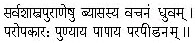
 

— “Amidst all the scriptures and Purânas, know this statement of Vyâsa to be true, that doing good to others conduces to merit, and doing harm to them leads to sin.”
Isn’t it true?
My brother, in view of all this, specially of the poverty and ignorance, I had no sleep. At Cape Comorin sitting in Mother Kumari’s temple, sitting on the last bit of Indian rock — I hit upon a plan: We are so many Sannyasins wandering about, and teaching the people metaphysics — it is all madness. Did not our Gurudeva use to say, “An empty stomach is no good for religion”? That those poor people are leading the life of brutes is simply due to ignorance. We have for all ages been sucking their blood and trampling them underfoot.
. . . Suppose some disinterested Sannyasins, bent on doing good to others, go from village to village, disseminating education and seeking in various ways to better the condition of all down to the Chandâla, through oral teaching, and by means of maps, cameras, globes, and such other accessories — can’t that bring forth good in time? All these plans I cannot write out in this short letter. The long and the short of it is — if the mountain does not come to Mohammed, Mohammed must go to the mountain. The poor are too poor to come to schools and Pâthashâlâs, and they will gain nothing by reading poetry and all that sort of thing. We, as a nation, have lost our individuality, and that is the cause of all mischief in India. We have to give back to the nation its lost individuality and raise the masses. The Hindu, the Mohammedan, the Christian, all have trampled them underfoot. Again the force to raise them must come from inside, that is, from the orthodox Hindus. In every country the evils exist not with, but against, religion. Religion therefore is not to blame, but men.
To effect this, the first thing we need is men, and the next is funds. Through the grace of our Guru I was sure to get from ten to fifteen men in every town. I next travelled in search of funds, but do you think the people of India were going to spend money! . . . . Selfishness personified — are they to spend anything? Therefore I have come to America, to earn money myself, and then return to my country and devote the rest of my days to the realisation of this one aim of my life.
As our country is poor in social virtues, so this country is lacking in spirituality. I give them spirituality, and they give me money. I do not know how long I shall take to realise my end. …These people are not hypocrites, and jealousy is altogether absent in them. I depend on no one in Hindusthan. I shall try to earn the wherewithal myself to the best of my might and carry out my plans, or die in the attempt. ” — When death is certain, it is best to sacrifice oneself for a good cause.”
You may perhaps think what Utopian nonsense all this is! You little know what is in me. If any of you help me in my plans, all right, or Gurudeva will show me the way out. … We cannot give up jealousy and rally together. That is our national sin!! It is not to be met with in this country, and this is what has made them so great.
Nowhere in the world have I come across such “frogs-in-the-well” as we are. Let anything new come from some foreign country, and America will be the first to accept it. But we? — oh, there are none like us in the world, we men of Aryan blood!! Where that heredity really expresses itself, I do not see. …Yet they are descendants of the Aryans?

Ever yours,

VIVEKANANDA.

To Mrs. G. W. Hale

Detroit
Tuesday, 27 March 1894
Dear Mother,
Herewith I send two cheques of $114 and $75 to be put in the banks for me. I have endorsed them to your care.
I am going to Boston in a day or two. I have got $57 with me. They will go a long way. Something will turn up, as it always does. I do not know where I go from Boston. I have written to Mrs. [Francis W.] Breed but as yet heard nothing from her. 24 His will be done. Not I but Thou–that is always the motto of my life.
With my eternal gratitude, love, and admiration for Mother Church and all the dignitaries,
I remain your son,
Vivekananda.

To Rev. R.A. Hume.

DETROIT,
29th March, 1894.
DEAR BROTHER,

Your letter just reached me here. I am in a hurry, so excuse a few points which I would take the liberty of correcting you in.

In the first place, I have not one word to say against any religion or founder of religion in the world — whatever you may think of our religion. All religions are sacred to me. Secondly, it is a misstatement that I said that missionaries do not learn our vernaculars. I still stick to my statement that few, if any, of them pay any attention to Sanskrit; nor is it true that I said anything against any religious body — except that I do insist on my statement that India can never be converted to Christianity, and further I deny that the conditions of the lower classes are made any better by Christianity, and add that the majority of southern Indian Christians are not only Catholics, but what they call themselves, caste Christians, that is, they stick close to their castes, and I am thoroughly persuaded that if the Hindu society gives up its exclusive policy, ninety per cent of them would rush back to Hinduism with all its defects.
Lastly, I thank you from the bottom of my heart for calling me your fellow-countryman. This is the first time any European foreigner, born in India though he be, has dared to call a detested native by that name — missionary or no missionary. Would you dare call me the same in India? Ask your missionaries, born in India, to do the same — and those not born, to treat them as fellow human beings. As to the rest, you yourself would call me a fool if I admit that my religion or society submits to be judged by strolling globe-trotters or story-writers’ narratives.
My brother — excuse me — what do you know of my society or religion, though born in India? It is absolutely impossible — the society is so closed; and over and above, everyone judges from his preconceived standard of race and religion, does he not? Lord bless you for calling me a fellow-countryman. There may still come a brotherly love and fellowship between the East and West.
Yours fraternally,
VIVEKANANDA

To Miss Mary Hale


DETROIT,
30th March, 1894.
DEAR SISTER,
Your and Mother Church’s letters came together just now, acknowledging the receipt of the money. I am very glad to receive the Khetri letter, which I send back for your perusal. You would find from it that he wants some newspaper clippings. I do not think I have any except the Detroit one, which I will send to him. If you can get hold of some others, kindly send some over to him if it be possible and convenient. You know his address — H. H. the Maharajah of Khetri, Rajputana, India. Of course, this letter is for the perusal of the holy family alone. Mrs. Breed wrote to me a stiff burning letter first, and then today I got a telegram from her inviting me to be her guest for a week. Before this I got a letter from Mrs. Smith of New York writing on her behalf and another lady Miss Helen Gould and another Dr.__ to come over to New York. As the Lynn Club wants me on the 17th of next month, I am going to New York first and come in time for their meeting at Lynn.
Next summer, if I do not go away, which Mrs. Bagley insists I should not, I may go to Annisquam where Mrs. Bagley has engaged a nice house. Mrs. Bagley is a very spiritual lady, and Mr. Palmer a spirituous gentleman but very good. What shall I write more? I am all right in nice health of body and mind. May you all be blessed, ever blessed, my dear, dear sisters. By the by, Mrs. Sherman has presented me with a lot of things amongst which is a nail set and letter holder and a little satchel etc., etc. Although I objected, especially to the nail set, as very dudish with mother-of-pearl handles, she insisted and I had to take them, although I do not know what to do with that brushing instrument. Lord bless them all. She gave me one advice — never to wear this Afrikee dress in society. Now I am a society man! Lord! What comes next? Long life brings queer experiences! My inexpressible love for you all, my holy family.

Your brother,

VIVEKANANDA.

To Swami Akhandananda

Salutation to Bhagavan Ramakrishna!
(March or April?) 1894
{original in Bengali}
My dear Akhandananda,
I am very glad to receive your letter. It is a great pleasure to me to learn that you have regained your health to a great extent by your stay at Khetri.
Brother Tarak (Shivananda) has done a good deal of work in Madras. Very agreeable news indeed! I heard much praise of him from the people of Madras. . . .
Try to develop spirituality and philanthropy amongst the Thakurs in the different places of Rajputana. We must work, and this cannot be done by merely sitting idle. Make a trip now and then to Malsisar, Alsisar, and all the other “sars” that are there. And carefully learn Sanskrit and English. Gunanidhi is in the Punjab, I presume. Convey my special love to him and bring him to Khetri. Learn Sanskrit with his help, and teach him English. Let me have his address by all means. . . .
Go from door to door amongst the poor and lower classes of the town of Khetri and teach them religion. Also, let them have oral lessons on geography and such other subjects. No good will come of sitting idle and having princely dishes, and saying “Ramakrishna, O Lord!”–unless you can do some good to the poor. Go to other villages from time to time, and teach the people the arts of life as well as religion. Work, worship, and Jnana (knowledge)–first work, and your mind will be purified; otherwise everything will be fruitless like pouring oblations on a pile of ashes instead of in the sacred fire. When Gunanidhi comes, move from door to door of the poor and the destitute in every village of Rajputana. If people object to the kind of food you take, give it up immediately. It is preferable to live on grass for the sake of doing good to others. The Gerua robe is not for enjoyment. It is the banner of heroic work. You must give your body, mind, and speech to “the welfare of the world”. You have read–“Look upon your mother as God, look upon your father as God”–but I say “The poor, the illiterate, the ignorant, the afflicted–let these be your God.” Know that service to these alone is the highest religion.
Ever yours, with blessings,
Vivekananda