Ramakrishna Sarada Mission, Dirang, Arunachal Pradesh

The Ramakrishna Sarada Mission has been educating tribal girls in Arunachal Pradesh for the last 37 years, ever since 1973 with its school in Khonsa, a remote corner of the district of Tirap. The Khonsa school is now a premier quality educational institution, highly prized by the State. It is especially rewarding that so many tribal girls educated in the school have become well established in different abilities, an asset to their communities capable of solving social problems, and eager to serve their Motherland.

The success of the Khonsa school prompted requests from all over Arunachal Pradesh for the Ramakrishna Sarada Mission to develop similar schools in their other districts.

In 2007, the Ramakrishna Sarada Mission finally accepted the earnest invitation of the people of Dirang and their local MLAs and Ministers, to run a school in their district. There are nearly 420 villages in West Kameng and Tawang, mainly inhabited by the Monpa tribe of Arunachal Pradesh. As this locality is a border state with a low female rate, creating awareness of the need for women’s education will have a large social impact.

The Monpa tribal children, and especially the girls, will not only improve their own living conditions but will raise future generations with the values and motivation to put a proud smile on the face of our nation. India’s patriotic prophet Swami Vivekananda laid great emphasis on the education of women as a key factor in uplifting the masses and building a new India.

The new Dirang project was launched in February 2008 by the Chief Minister himself in the presence of the leading Monpas of the district. Ten acres of land were donated on the bank of the Kyamani River about 15 km from the Dirang Township.

Three years down the line a few buildings have come up, though much more needs to be done. The dedicated efforts of a few sincere people have made the construction a reality so far in the face of innumerable hurdles. Without their help this project would still be a dream. DoNER of the Central Ministry has provided funds for the construction of the school, the hostel, and several other buildings. The infrastructure is well underway, and requests are already being received for the Ramakrishna Sarada Mission to open the school this year.

Arunachal Pradesh, although famous for its scenic beauty, is still not a well- developed State and it lacks a stable economy. It will not be possible to sustain this project with State funds alone. This challenging project in the far Northeast, whichshares its borders with China and Bhutan, has fostered an overwhelming response from the general public all over India. What is needed now is the active cooperation
and collaboration from interested organizations throughout our country.

About the School

Ramakrishna Sarada Mission centre at Dirang was officially inaugurated by Most Revered Pravrajika Amalaprana Mataji, General Secretary, Sri Sarada Math & Ramakrishna Sarada Mission on the auspicious day of Buddha Purnima on 17th May 2011; school was started with 49 residential students from Arunachal Pradesh in general and from West Kameng and Tawang Districts in particular.

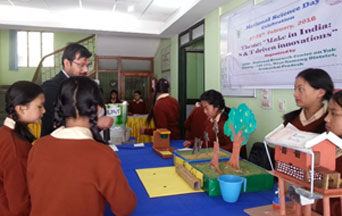
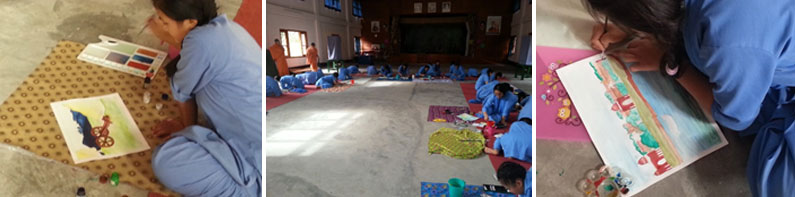
In each successive year a new class is added to accommodate the current batch of students and currently the student strength stands at 236 (2016-2017). Over the last 6 years the school has created a rigorous internal assessment system to evaluate the performance of students, including “Formative and Summative Tests”. The school lays great emphasis on developing the overall personality of the child, keeping the traditional customs as it is. To achieve this goal, several competitions and events including Recitation, Drawing, Extempore, Story Writing, Story Telling, Quiz, Science Day, Sports Day, Arunachal Day and National Youth Day are organized with much zeal. Many of these competitions are conducted by external organizations and Ramakrishna Sarada Mission Girls’ School has won the top prizes in most of these competitions. The students of the school have a special talent for painting and have participated in several competitions, including State Level.


Students have participated in Quiz Competitions conducted at National YAK Centre & won top prizes competing with other schools of the district

Students participate in the Science Exhibition conducted at National YAK Research Centre every year and have won top prizes

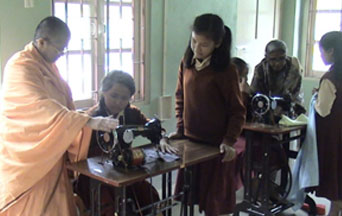
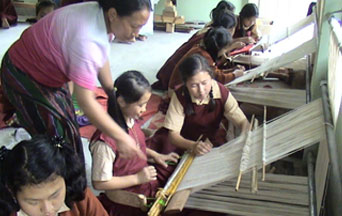
Regular extra-curricular activities, forming a part of their overall assessment include, Yoga, Drawing/Painting and Vocational Training. Vocational training includes embroidery, stitching and weaving which is separately taught, with a view to specifically promote the culture of the region.

The students of the school have a special talent for painting and have participated in several competitions, including State Level.

The school also runs the “Know Your Country” project, in which students and escorts from Kolkata visit the school. This project aims at increasing interaction amongst students from various regions and promoting exposure and awareness about our country & culture.

Apart from providing exposure to students to other regions in the country, the goal is to create a unified school, bringing together students from different regions in Arunachal Pradesh under one roof, to intermingle and learn from diversity.

How to integrate the students from the North-East with those from other regions of the country is one of the paramount goals of the institution. With this in mind, we are focused on creating an institution that provides the best-in-class facilities and resources to the students.


Building a culture of Discipline and Service

Building self-discipline and an attitude of service is strongly encouraged in the student through a process of allotting hostel and school routine duties for all students. Personal responsibility is expected for daily conduct and for the maintenance of harmony of the institution through a process of Continuous Assessment which evaluates students on discipline, behaviour and willingness to take up responsibilities in the betterment of their school.


Extra-Curricular Activities

Students learning stitching & embroidery as part of Vocational Training

Students learning the local art of weaving as part of Vocational Training

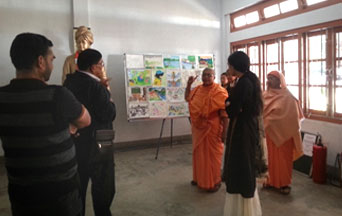
The Deputy Commissioner for West Kameng being shown students’ artwork

Apart from regular subjects, the children learn Art, Yoga, play a variety of Games and borrow books over the weekend from the School Library. Occasional trips outside the school are undertaken to explore the vast expanse of natural beauty, which surrounds the school.

The students are exposed to the richness of Ancient Indian History and Culture through the medium of audio-visual. Documentaries on India ranging from Partition of India, Bharat Ek Khoj Series, Upanishad Ganga Series, Discovery and National Geographic channel Series, Ramayana, Mahabharata and children’s movies are shown to the children regularly to expose them to the glory of our country. Weekends are often spent in gardening, cleaning the Mission Campus, playing indoor games in the Hostel courtyard or relaxing with a library book. On Saturdays, either a book reading or an informal chat with the children is conducted to share anecdotes and inspiring stories from the lives of Great Personalities and to allow the children an opportunity to interact closely with the staff.

As part of the yearly functions – children write scripts for dramas and stage the dramas with a variety of themes, the favourite themes being the Epics, Lives of Freedom Fighters such as Bhagat Singh and incidents from the lives of the Holy Trio – Sri Ramakrishna, Sri Sarada Devi and Swami Vivekananda. Local Traditional Tribal Dances including Bamboo dance are often staged at these functions with the children dressing up in their traditional attire and displaying the uniqueness of their state using various materials. On this special occasion senior children prepare local dishes.

Ramakrishna Sarada Mission
Dirang Circle, Khasso,
West Kameng Dist. 790101
Phones : (03780) 200367 & 200368
e-mail:[email protected]

Address and Activities of Karimganj Centre

Ramakrishna Math and Ramakrishna Mission Seva Samiti, Karimganj

Ramakrishna Math and Ramakrishna Mission Seva Samiti
Karimganj, Assam  788710-07
India
Phone : 03843-262272
Email : [email protected], [email protected]
Website: www.rkmkarimganj.org


The Seva Samiti (Mission centre) was started in 1917 and taken over in 1929. The Math centre was founded in 1949.

Activities of the Math centre :


  1. Daily worship and religious classes in and outside the Ashrama
    premises.
  1. Celebration of Durga Puja, Kali Puja, and the birth anniversaries
    of Sri Ramakrishna, Holy Mother Sri Sarada Devi, Swami
    Vivekananda, and other prophets.

  1. Welfare service by way of providing clothing and medical help
    to the needy and study materials to poor students.


Activities of the Mission centre :


  1. A students’ home with 16 students.

  1. A library and a reading room with 3689 books, and 20 periodicals
    and dailies.
  1. Sunday moral classes with 20 children.
  1. A mobile medical unit, which treated 18,452 cases this year.

  1. Welfare activities by way of providing blankets to poor and
    needy people.

Additional Photos of the Activities of the Centre:

Relief
Fire Help

    Educational
Library and Reading Room

        Vocational Training Centre

    Medical
Eye Camp

    Relief
Flood

        Clothes and Garments

    Spiritual
Durga Puja

        Kali Puja

        Saraswati Puja

    Temple
Temple

    Welfare
Welfare

 W S    A R C H I V E


THE VEDANTA PHILOSOPHY

The Vedanta philosophy, as it is generally called at the present day, really comprises all the various sects that now exist in India. Thus there have been various interpretations, and to my mind they have been progressive, beginning with the dualistic or Dvaita and ending with the non-dualistic or Advaita. The word Vedanta literally means the end of the Vedas — the Vedas being the scriptures of the Hindus.1 Sometimes in the West by the Vedas are meant only the hymns and rituals of the Vedas. But at the present time these parts have almost gone out of use, and usually by the word Vedas in India, the Vedanta is meant. All our commentators, when they want to quote a passage from the scriptures, as a rule, quote from the Vedanta, which has another technical name with the commentators — the Shrutis. (The term Shruti — meaning “that which is heard” — though including the whole of the Vedic literature, is chiefly applied by the commentators to the Upanishads.) Now, all the books known by the name of the Vedanta were not entirely written after the ritualistic portions of the Vedas. For instance, one of them — the Ishâ Upanishad — forms the fortieth chapter of the Yajur-Veda, that being one of the oldest parts of the Vedas. There are other Upanishads2 which form portions of the Brahmanas or ritualistic writings; and the rest of the Upanishads are independent, not comprised in any of the Brahmanas or other parts of the Vedas; but there is no reason to suppose that they were entirely independent of other parts, for, as we well know, many of these have been lost entirely and many of the Brahmanas have become extinct. So it is quite possible that the independent Upanishads belonged to some Brahmanas, which in course of time fell into disuse, while the Upanishads remained. These Upanishads are also called Forest Books or Aranyakas.

The Vedanta, then, practically forms the scriptures of the Hindus, and all systems of philosophy that are orthodox have to take it as their foundation. Even the Buddhists and Jains, when it suits their purpose, will quote a passage from the Vedanta as authority. All schools of philosophy in India, although they claim to have been based upon the Vedas, took different names for their systems. The last one, the system of Vyâsa, took its stand upon the doctrines of the Vedas more than the previous systems did, and made an attempt to harmonise the preceding philosophies, such as the Sânkhya and the Nyâya, with the doctrines of the Vedanta. So it is especially called the Vedanta philosophy; and the Sutras or aphorisms of Vyasa are, in modern India, the basis of the Vedanta philosophy. Again, these Sutras of Vyasa have been variously explained by different commentators. In general there are three sorts of commentators3 in India now; from their interpretations have arisen three systems of philosophy and sects. One is the dualistic, or Dvaita; a second is the qualified non-dualistic, or Vishishtâdvaita; and a third is the non-dualistic, or Advaita. Of these the dualistic and the qualified non-dualistic include the largest number of the Indian people. The non-dualists are comparatively few in number. Now I will try to lay before you the ideas that are contained in all these three sects; but before going on, I will make one remark — that these different Vedanta systems have one common psychology, and that is, the psychology of the Sankhya system. The Sankhya psychology is very much like the psychologies of the Nyaya and Vaisheshika systems, differing only in minor particulars.

All the Vedantists agree on three points. They believe in God, in the Vedas as revealed, and in cycles. We have already considered the Vedas. The belief about cycles is as follows: All matter throughout the universe is the outcome of one primal matter called Âkâsha; and all force, whether gravitation, attraction or repulsion, or life, is the outcome of one primal force called Prâna. Prana acting on Akasha is creating or projecting4 the universe. At the beginning of a cycle, Akasha is motionless, unmanifested. Then Prana begins to act, more and more, creating grosser and grosser forms out of Akasha — plants, animals, men, stars, and so on. After an incalculable time this evolution ceases and involution begins, everything being resolved back through finer and finer forms into the original Akasha and Prana, when a new cycle follows. Now there is something beyond Akasha and Prana. Both can be resolved into a third thing called Mahat — the Cosmic Mind. This Cosmic Mind does not create Akasha and Prana, but changes itself into them.

We will now take up the beliefs about mind, soul, and God. According to the universally accepted Sankhya psychology, in perception — in the case of vision, for instance — there are, first of all, the instruments of vision, the eyes. Behind the instruments — the eyes — is the organ of vision or Indriya — the optic nerve and its centres — which is not the external instrument, but without which the eyes will not see. More still is needed for perception. The mind or Manas must come and attach itself to the organ. And besides this, the sensation must be carried to the intellect or Buddhi — the determinative, reactive state of the mind. When the reaction comes from Buddhi, along with it flashes the external world and egoism. Here then is the will; but everything is not complete. Just as every picture, being composed of successive impulses of light, must be united on something stationary to form a whole, so all the ideas in the mind must be gathered and projected on something that is stationary — relatively to the body and mind — that is, on what is called the Soul or Purusha or Âtman.

According to the Sankhya philosophy, the reactive state of the mind called Buddhi or intellect is the outcome, the change, or a certain manifestation of the Mahat or Cosmic Mind. The Mahat becomes changed into vibrating thought; and that becomes in one part changed into the organs, and in the other part into the fine particles of matter. Out of the combination of all these, the whole of this universe is produced. Behind even Mahat, the Sankhya conceives of a certain state which is called Avyakta or unmanifested, where even the manifestation of mind is not present, but only the causes exist. It is also called Prakriti. Beyond this Prakriti, and eternally separate from it, is the Purusha, the soul of the Sankhya which is without attributes and omnipresent. The Purusha is not the doer but the witness. The illustration of the crystal is used to explain the Purusha. The latter is said to be like a crystal without any colour, before which different colours are placed, and then it seems to be coloured by the colours before it, but in reality it is not. The Vedantists reject the Sankhya ideas of the soul and nature. They claim that between them there is a huge gulf to be bridged over. On the one hand the Sankhya system comes to nature, and then at once it has to jump over to the other side and come to the soul, which is entirely separate from nature. How can these different colours, as the Sankhya calls them, be able to act on that soul which by its nature is colourless? So the Vedantists, from the very first affirm that this soul and this nature are one.5 Even the dualistic Vedantists admit that the Atman or God is not only the efficient cause of this universe, but also the material cause. But they only say so in so many words. They do not really mean it, for they try to escape from their conclusions, in this way: They say there are three existences in this universe — God, soul, and nature. Nature and soul are, as it were, the body of God, and in this sense it may be said that God and the whole universe are one. But this nature and all these various souls remain different from each other through all eternity. Only at the beginning of a cycle do they become manifest; and when the cycle ends, they become fine, and remain in a fine state. The Advaita Vedantists — the non-dualists — reject this theory of the soul, and, having nearly the whole range of the Upanishads in their favour, build their philosophy entirely upon them. All the books contained in me Upanishads have one subject, one task before them — to prove the following theme: “Just as by the knowledge of one lump of clay we have the knowledge of all the clay in the universe, so what is that, knowing which we know everything in the universe?” The idea of the Advaitists is to generalise the whole universe into one — that something which is really the whole of this universe. And they claim that this whole universe is one, that it is one Being manifesting itself in all these various forms. They admit that what the Sankhya calls nature exists, but say that nature is God. It is this Being, the Sat, which has become converted into all this — the universe, man, soul, and everything that exists. Mind and Mahat are but the manifestations of that one Sat. But then the difficulty arises that this would be pantheism. How came that Sat which is unchangeable, as they admit (for that which is absolute is unchangeable), to be changed into that which is changeable, and perishable? The Advaitists here have a theory which they call Vivarta Vâda or apparent manifestation. According to the dualists and the Sankhyas, the whole of this universe is the evolution of primal nature. According to some of the Advaitists and some of the dualists, the whole of this universe is evolved from God. And according to the Advaitists proper, the followers of Shankaracharya, the whole universe is the apparent evolution of God. God is the material cause of this universe, but not really, only apparently. The celebrated illustration used is that of the rope and the snake, where the rope appeared to be the snake, but was not really so. The rope did not really change into the snake. Even so this whole universe as it exists is that Being. It is unchanged, and all the changes we see in it are only apparent. These changes are caused by Desha, Kâla and Nimitta (space, time, and causation), or, according to a higher psychological generalization, by Nâma and Rupa (name and form). It is by name and form that one thing is differentiated from another. The name and form alone cause the difference. In reality they are one and the same. Again, it is not, the Vedantists say, that there is something as phenomenon and something as noumenon. The rope is changed into the snake apparently only; and when the delusion ceases, the snake vanishes. When one is in ignorance, he sees the phenomenon and does not see God. When he sees God, this universe vanishes entirely for him. Ignorance or Mâyâ, as it is called, is the cause of all this phenomenon — the Absolute, the Unchangeable, being taken as this manifested universe. This Maya is not absolute zero, nor non-existence. It is defined as neither existence nor non-existence. It is not existence, because that can be said only of the Absolute, the Unchangeable, and in this sense, Maya is non-existence. Again, it cannot be said it is non-existence; for if it were, it could never produce phenomenon. So it is something which is neither; and in the Vedanta philosophy it is called Anirvachaniya or inexpressible. Maya, then, is the real cause of this universe. Maya gives the name and form to what Brahman or God gives the material; and the latter seems to have been transformed into all this. The Advaitists, then, have no place for the individual soul. They say individual souls are created by Maya. In reality they cannot exist. If there were only one existence throughout, how could it be that I am one, and you are one, and so forth? We are all one, and the cause of evil is the perception of duality. As soon as I begin to feel that I am separate from this universe, then first comes fear, and then comes misery. “Where one hears another, one sees another, that is small. Where one does not see another, where one does not hear another, that is the greatest, that is God. In that greatest is perfect happiness. In small things there is no happiness.”

According to the Advaita philosophy, then, this differentiation of matter, these phenomena, are, as it were, for a time, hiding the real nature of man; but the latter really has not been changed at all. In the lowest worm, as well as in the highest human being, the same divine nature is present. The worm form is the lower form in which the divinity has been more overshadowed by Maya; that is the highest form in which it has been least overshadowed. Behind everything the same divinity is existing, and out of this comes the basis of morality. Do not injure another. Love everyone as your own self, because the whole universe is one. In injuring another, I am injuring myself; in loving another, I am loving myself. From this also springs that principle of Advaita morality which has been summed up in one word — self-abnegation. The Advaitist says, this little personalised self is the cause of all my misery. This individualised self, which makes me different from all other beings, brings hatred and jealousy and misery, struggle and all other evils. And when this idea has been got rid of, all struggle will cease, all misery vanish. So this is to be given up. We must always hold ourselves ready, even to give up our lives for the lowest beings. When a man has become ready even to give up his life for a little insect, he has reached the perfection which the Advaitist wants to attain; and at that moment when he has become thus ready, the veil of ignorance falls away from him, and he will feel his own nature. Even in this life, he will feel that he is one with the universe. For a time, as it were, the whole of this phenomenal world will disappear for him, and he will realise what he is. But so long as the Karma of this body remains, he will have to live. This state, when the veil has vanished and yet the body remains for some time, is what the Vedantists call the Jivanmukti, the living freedom. If a man is deluded by a mirage for some time, and one day the mirage disappears — if it comes back again the next day, or at some future time, he will not be deluded. Before the mirage first broke, the man could not distinguish between the reality and the deception. But when it has once broken, as long as he has organs and eyes to work with, he will see the image, but will no more be deluded. That fine distinction between the actual world and the mirage he has caught, and the latter cannot delude him any more. So when the Vedantist has realised his own nature, the whole world has vanished for him. It will come back again, but no more the same world of misery. The prison of misery has become changed into Sat, Chit, Ânanda — Existence Absolute, Knowledge Absolute, Bliss Absolute — and the attainment of this is the goal of the Advaita Philosophy.

(The above address was delivered before the Graduate Philosophical Society of Harvard University, on March 25, 1896.)

Harbert residence, 1412 Judson Ave., Evanston

Harbert Residence

Swamiji spoke on the subject “Reincarnation” at the Harbert Residence in Evanston. He pointed out the popular error which exists concerning the passing of humanity into animal forms. He said that “It was a mistaken idea to think that his people were so careful of animals because they thought some former human being was now living in the form of the animal. On the contrary, it is simply a part of their religion to be kind to animals. Reincarnation is either progression, which is advancement to a higher type of manhood, or retrogression, which is the relapse of humanity to a lower plane of living.”

Elisha Grey residence, 461 Hazel Ave., Highland Park

Elisha Gray
Elisha Grey’s residence


Elisha Gray was a famous electrical engineer and inventor who held over seventy patents to his credit. He was chairman of the Internal Electrical Congress, which had been held in conjunction with the Columbian Exposition, and his teleautograph machine to transmit facsimile was one of the exhibits in the Electrical Building at the Exposition

Immediately following the Parliament, Swamiji was invited to the house of Mr. Elisha Gray. The guests at the vegetarian dinner, given in Swamiji’s honor, were some very illustrious scientists and engineers. The British physicist Sir William Thomson (Lord Kelvin), Prof. Hermann Von Helmholtz, Prof. Edourd Hospitalier were all there along with other distinguished people.

Charles C. Bonney

Charles C. Bonney was a well-known judge in Chicago and the author of many important constitutional and economic reforms. He was the President of the World’s Congress Auxiliary of the Columbian Exposition and it was Bonney’s inspiration and idea to hold the Parliament of Religions as part of the Congress in order to, as he said in his welcome address, “unite all Religion against all irreligion; to make the golden rule the basis for this union; and to present to the world the substantial unity of many religions in the good deeds of religious life”. Charles Bonney gave a huge reception in the upper floor and halls of the Art Institute (at that time known as the World’s Congress Auxiliary Building) in the evening of September 12 for the delegates. Swamiji attended as reported by the Inter Ocean — “…Vivi Kananda [sic] came next and had a happy reception and was very much at home.”

Cornelia Conger

Cornelia Conger, was the granddaughter of Mr. and Mrs. John Lyons, the Swami’s first hosts in Chicago in September 1893. She was six years old when she met the Swami and wrote of him in part:

“He seemed to feel especially close to my grandmother, who reminded him of his own mother. She was short and very erect, with quiet dignity and assurance, excellent common sense, and a dry humor that he enjoyed. My mother, who was a pretty and charming young widow, and I-who was only six years old-lived with them. My grandmother and my mother attended most of the meetings of the Congress of Religions and heard Swamiji speak there and later at lectures he gave. I know he helped my sad young mother who missed her young husband so much. . . .

My memories are simply of him as a guest in our home-of a great personality who is still vivid to me! His brilliant eyes, his charming voice with the lilt of a slight well-bred Irish brogue, his warm smile! He told me enchanting stories of India , of monkeys and peacocks, and flights of bright green parrots, of banyan trees and masses of flowers, and markets piled with all colors of fruits and vegetables. . . . I used to rush up to him when he came into the house and cry, “Tell me another Story, Swami,” and climb into his lap. . . . He was always wonderful to me! Yet-because a child is sensitive-I can remember times when I would run into his room and suddenly know he did not want to be disturbed-when he was in meditation. He asked me many questions about what I learned in school and made me show him my school-books and pointed out India to me on the map-it was pink, I recall and told me about his country: He seemed sad that little Indian girls did not have, in general, the chance to have as good an education as we American children. . . . My grandmother was president of the Women’s Hospital at home and he visited it with lively interest and asked for all the figures in infant mortality, etc.

When he began to give lectures, people offered him money for the work he hoped to do in India . He had no purse. So he used to tie it up in a handkerchief and bring it back-like a proud little boy!-pour it into my grandmother’s lap to keep for him. She made him learn the different coins and to stack them up neatly and count them.

Once he said to my grandmother that he had had the greatest temptation of his life in America . She liked to tease him a bit and said, “Who is she, Swami?” He bum out laughing and said, “Oh, it is not a lady, it is Organization!” He explained how the followers of Ramakrishna had all gone out alone and when they reached a village, would just quietly sit under a tree and wait for those in trouble to come to consult them. But in the States he saw how much could be accomplished by organizing work. Yet he was doubtful about just what type of organization would be acceptable to the Indian character and he gave a great deal of thought and study how to adapt what seemed good to him in our Western world to the best advantage of his own people. . . . I spoke earlier of his delightful slight Irish brogue. . . . My grandmother used to joke him about it. But Swami said it was probably because his favorite professor was an Irish gentleman, a graduate of Trinity College , Dublin . . . .

After Swami left us, my mother was eager to do some studying along the lines of Oriental philosophy, as she realized she had not enough background to understand his teachings as fully as she wished. A Mrs. Peake held some classes in Chicago that following winter and, in the course of them, mother discovered much to her surprise that if she held a letter torn up into fine bits between her hands, she received a brief but vivid impression of the writer, both physically and mentally. When Swamiji returned to Chicago a year or so later to give lectures, mother asked him about this strange gift and he said, he had it also, and that when he was young he used to have fun doing it to show off, but Ramakrishna had rapped his knuckles and said, “Don’t use this great gift except for the good of mankind! Hands that receive these impressions can also bring relief from pain. Use this gift to bring healing!”

Swamiji was such a dynamic and attractive personality that many women were quite swept away by him and made every effort by flattery to gain his interest. He was still young and, in spite of his great spirituality and his brilliance of mind, seemed to be very unworldly. This used to trouble my grandmother who feared he might be put in a false or uncomfortable position and she tried to caution him a little. Her concern touched and amused him and he patted her hand and, said, “Dear Mrs. Lyon, you dear American mother of mine, don’t be afraid for me! It is true I often sleep under a banyan tree with a bowl of rice given me by a kindly peasant, but it is equally true that I also am sometimes the guest in the palace of a great Maharajah and a slave girl is appointed to wave a peacock feather fan over roe all night long! I am used to temptation and you need not fear for me!”


BEFORE the Congress (or Parliament) of Religions met in Chicago at the time of the Columbian Exposition in 1893. members of various Churches volunteered to ask into their homes as guests delegates to it. My grandmother, Mrs. John B. Lyon, was one of these, requesting, if possible, that a delegate who was broad-minded be sent to us, as my grandfather was much interested in philosophy but heartily disliked bigots. Our home was 262 Michigan Avenue, a pleasant somewhat old-fashioned frame-house, painted olive green with boxes of red geraniums across the front. It was full of guests all that summer as my grandparents were naturally hospitable and this World’s Fair was a very exciting and fascinating affair. So all our out-of-town relatives and friends were eager to come to Chicago to see it. When word came that our delegate was to arrive on a certain evening, the house was so crowded that my grandmother had to send her elder son to a friend’s house to have his room for our guest. We had been given no idea who he would be, nor even what religion he was representing. A message came that a member of our Church — the First Presbyterian — would bring him after midnight. Everyone went to bed except my grandmother who waited up to receive them. When she answered the door-bell, there stood Swami Vivekananda in a long yellow robe, a red sash, and a red turban — a very startling sight to her, because she had probably never seen an East Indian before. She welcomed him warmly and showed him to his room. When she went to bed, she was somewhat troubled. Some of our guests were Southerners, as we had many friends in the South, because we owned a sugar plantation on the Bayou Teche in Louisiana. Southerners have a strong dislike for associating with anyone but whites, because they stupidly think of all people who are darker as on a mental and social plane of their former negro slaves. My grandmother herself had no colour prejudice, and she was sufficiently intelligent any way to know that Indians are of the same Caucasian inheritance as we are.

When my grandfather woke up, she told him of the problem and said he must decide whether it would be uncomfortable for Swami and for our Southern friends to be together. If so, she said he could put Swami up as our guest at the new Auditorium Hotel near us. My grandfather was dressed about half an hour before breakfast and went into the library to read his morning paper. There he found Swami and, before breakfast was served, he came to my grandmother and said, “I don’t care a bit, Emily, if all our guests leave! This Indian is the most brilliant and interesting man who has ever been in our home. and he shall stay as long as he wishes.” That began a warm friendship between them which was later summed up — much to my grandfather’s embarrassment — by having Swami calmly remark to a group of my grandfather’s friends one day at the Chicago Club “I believe Mr. Lyon is the most Christlike man I ever met!”

He seemed to feel especially close to my grandmother, who reminded him of his own mother. She was short and very erect, with quiet dignity and assurance, excellent common sense, and a dry humour that he enjoyed. My mother, who was a pretty and charming young widow, and I — who was only six years old — lived with them. My grandmother and my mother attended most of the meetings of the Congress of Religions and heard Swamiji speak there and later at lectures he gave. I know he helped my sad young mother who missed her young husband so much. Mother read and studied Swamiji’s books later and tried to follow his teachings.

My memories are simply of him as a guest in our home — of a great personality who is still vivid to me! His brilliant eyes, his charming voice with the lilt of a slight well-bred Irish brogue. his warm smile! He told me enchanting stories of India, of monkeys and peacocks, and flights of bright green parrots, of banyan trees and masses of flowers, and markets piled with all colours of fruits and vegetables. To me they sounded like fairy-tales, but now that I have driven over many hundreds of miles of Indian roads. I realize that he was simply describing scenes from the memories of his own boyhood. I used to rush up to him when he came into the house and cry “Tell me another story, Swami”, and climb into his lap. Perhaps, so far from home and in so strange a country, he found comfort in the love and enthusiasm of a child. He was always wonderful to me. Yet — because a child is sensitive — I can remember times when I would run into his room and suddenly know he did not want to be disturbed — when he was in meditation. He asked me many questions about what I learnt in school and made me show him my school-books and pointed out India to me on the map — it was pink. I recall — and told me about his country. He seemed sad that little Indian girls did not have, in general, the chance to have as good an education as we American children. Imagine how interested I was when Swami Shankarananda, President, Belur Math, told me he founded a girls’ school in Calcutta!

My grandmother was president of the Women’s Hospital at home, and he visited it with lively interest and asked for all the figures in infant mortality etc. So again it showed how much he was learning in our country to be used in helping his own people, because I was told that a maternity hospital was also founded later. How very happy that would have made my grandmother!

I was fascinated by his turban which struck me as a very funny kind of a hat, especially as it had to be wound up afresh every time he put it on! I persuaded him to let me see him wrap it back and forth around his head.

As our American food is less highly seasoned than Indian, my grandmother was afraid he might find it flat. He told us, on arrival, that he had been told to conform to all the customs and the food of his hosts, so he ate as we did. My grandmother used to make a little ceremony of making salad dressing at the table, and one of the condiments she used was Tabasco Sauce, put up by some friends of hers, the Mrs. Ilhennys, in Louisiana. She handed him the bottle and said, “You might like a drop or two of this on your meat, Swami”. He sprinkled it on with such a lavish hand that we all gasped and said, “But you can’t do that! It’s terribly hot!” He laughed and ate it with such enjoyment that a special bottle of the sauce was always put at his place after that.

My mother took him to hear his first Symphony Concert on a Friday afternoon. He listened with great attention but with his head a bit on one side and a slightly quizzical expression. “Did you enjoy it?” mother asked at the end. “Yes, it was very beautiful”, he replied, but mother felt it was said with some reservation. “What are you thinking?” she asked. “I am puzzled by two things”, he answered. “First, I do not understand why the programme says that this same programme will be repeated on Saturday evening. You see in India, one type of music is played at dawn. The music for noontime is very different, and that for the evening is also of a special character. So I should think that what sounds suitable to your ears in the early afternoon would not sound harmonious to you at night. The other thing that seems strange to me is the lack of overtones in the music and the greater intervals between the notes. To my ears it has holes in it like that good Swiss cheese you give me.”

When he began to give lectures, people offered him money for the work he hoped to do in India. He had no purse. So he used to tie it up in a handkerchief and bring it back — like a — proud little boy — pour it into my grandmother’s lap to keep for him. She made him learn the different coins and to stack them up neatly to count them. She made him write down the amount each time, and she deposited in her bank for him. He was overwhelmed by the generosity of his audience who seemed so happy to give to help people they had never seen so far away.

Once he said to my grandmother that he had had the greatest temptation of his life in America. She liked to tease him a bit and said, “Who is she, Swami?” He burst out laughing and said, “Oh, it is not a lady, it is Organization!” He explained how the followers of Ramakrishna had all gone out alone and when they reached a village, would just quietly sit under a tree and wait for those in trouble to come to consult them. But in the States he saw how much could be accomplished by organizing work. Yet he was doubtful about just what type of organization would be acceptable to the Indian character, and he gave a great deal of thought and study how to adapt what seemed good to him in our Western World to the best advantage of his own people. I can see that Belur Math and his many charities are the result of this period in his life. I spoke earlier of his delightful slight Irish brogue. I recall that this came as a surprise to Swami Shankarananda. My grandfather used to joke him about it. But Swami said it was probably because his favourite professor was an Irish gentleman, a graduate of Trinity College, Dublin.

After Swami left us, my mother was eager to do some studying along the lines of Oriental philosophy, as she realized she had not enough background to understand his teachings as fully as she wished. A Mrs. Peake held some classes in Chicago that following winter and, in the course of them, mother discovered much to her surprise that if she held a letter torn up into fine bits between her hands, she received a brief but vivid impression of the writer, both physically and mentally. When Swamiji returned to Chicago a year or so later to give lectures, mother asked him about this strange gift, and he said he had it also, and that when he was young, he used to have fun doing it to show off, but that Ramakrishna had wrapped his knuckles and said, “Don’t use this great gift except for the good of mankind. Hands that receive these impressions can also bring relief from pain. Use this gift to bring healing.”

On this second visit, he only stayed with us for a short time. He knew he could teach better if he lived in his own regime of food and of many hours for meditation. It also left him free to receive many who came to him for help. So my grandmother helped him find a simple but comfortable little, flat, bur I do not recall that I ever saw it.

Swamiji was such a dynamic and attractive personality that many women were quite swept away by him and made every effort by flattery to gain his interest. He was still young and, in spite of his great spirituality and his brilliance of mind, seemed to be very unworldly. This used to trouble my grandmother who feared he might be put in a false or uncomfortable position, and she tried to caution him a little. Her concern touched and amused him, and he patted her hand and said. “Dear Mrs. Lyon, you dear American mother of mine, don’t be afraid for me. It is true I often sleep under a banyan tree with a bowl of rice given me by a kindly peasant, but it is equally true that I also am sometimes the guest in the palace of a great Maharaja and a slave girl is appointed to wave a peacock feather fan over me all night long! I am used to temptation, and you need not fear for me!”

After having talked with Swami Shankarananda and been encouraged by him, I wished I had talked to my mother’s younger sister, Katharine (Mrs. Robert W. Hamill) about her recollections of Swamiji. So when I reached home I asked her what she could add to my scattered memories. She was a bride and had her own home. So she was not at her mother’s and father’s so very much. She recalled Swamiji much as I did, but never heard him lecture. However, she and her husband were “young intellectuals” and had a group of young professors from our university, young newspaper men, etc. around them. One Sunday evening she was telling them how remarkable Swamiji was, and they said that modern scientists and psychologists could “show up” his religious beliefs in no time! She said. “If I can persuade him to come here next Sunday evening, will you all come back and meet him?” They agreed, and Swamiji met them all at an informal supper party. My aunt does not recall just what subjects were brought up, but that the entire evening was a lively and interesting debate on all sorts of ideas — Aunt Katharine said that Swamiji’s great knowledge of the Bible and the Koran as well as the various Oriental religions, his grasp of science and of psychology were astounding. Before the evening was over, the “doubting Thomases” threw up their hands and admitted that Swamiji had held his own on every point and that they parted from him with warmest admiration and affection. —

When I was taken to meet Swami Shankarananda, I fell my memories were too childish and trivial to put down in black and white. I fell very humble and apologetic for taking up others’ time. But the Swami said something infinitely kind and gracious which I shall never forget: That every great man is like a jewel with many facets. That each facet is important as it reflects a different aspect of his character. That I had come to him to offer a facet that was lacking in his records of Swamiji — of the weeks he had spent in our home when he first left India. So here is my very tiny “facet” offered in memory of someone I have loved for all these 62 years — not as a teacher, nor a great religious leader — but as a wonderful and vivid friend who lived in our home.

(Prabuddha Bharata, May 1956)
Many opinions exist regarding the date of Swamiji’s departure from the Baranagore Math as a parivrajaka.

[fusion_builder_container hundred_percent=”no” equal_height_columns=”no” menu_anchor=”” hide_on_mobile=”small-visibility,medium-visibility,large-visibility” class=”” id=”” background_color=”” background_image=”” background_position=”center center” background_repeat=”no-repeat” fade=”no” background_parallax=”none” enable_mobile=”no” parallax_speed=”0.3″ video_mp4=”” video_webm=”” video_ogv=”” video_url=”” video_aspect_ratio=”16:9″ video_loop=”yes” video_mute=”yes” video_preview_image=”” border_size=”” border_color=”” border_style=”solid” margin_top=”” margin_bottom=”” padding_top=”” padding_right=”” padding_bottom=”” padding_left=””][fusion_builder_row][fusion_builder_column type=”1_1″ layout=”1_1″ spacing=”” center_content=”no” hover_type=”none” link=”” min_height=”” hide_on_mobile=”small-visibility,medium-visibility,large-visibility” class=”” id=”” background_color=”” background_image=”” background_position=”left top” background_repeat=”no-repeat” border_size=”0″ border_color=”” border_style=”solid” border_position=”all” padding=”” dimension_margin=”” animation_type=”” animation_direction=”left” animation_speed=”0.3″ animation_offset=”” last=”no”][fusion_title margin_top=”” margin_bottom=”” hide_on_mobile=”small-visibility,medium-visibility,large-visibility” class=”” id=”” size=”4″ content_align=”center” style_type=”default” sep_color=””]

Explanatory notes (E.N.) 1890

E.N.90.4 (Text page: 20 July)

[/fusion_title][/fusion_builder_column][/fusion_builder_row][/fusion_builder_container][fusion_builder_container hundred_percent=”no” equal_height_columns=”no” menu_anchor=”” hide_on_mobile=”small-visibility,medium-visibility,large-visibility” class=”” id=”” background_color=”” background_image=”” background_position=”center center” background_repeat=”no-repeat” fade=”no” background_parallax=”none” enable_mobile=”no” parallax_speed=”0.3″ video_mp4=”” video_webm=”” video_ogv=”” video_url=”” video_aspect_ratio=”16:9″ video_loop=”yes” video_mute=”yes” video_preview_image=”” border_size=”” border_color=”” border_style=”solid” margin_top=”” margin_bottom=”” padding_top=”” padding_right=”” padding_bottom=”” padding_left=””][fusion_builder_row][fusion_builder_column type=”1_3″ layout=”1_3″ spacing=”” center_content=”no” hover_type=”none” link=”” min_height=”” hide_on_mobile=”small-visibility,medium-visibility,large-visibility” class=”” id=”” background_color=”” background_image=”” background_position=”left top” background_repeat=”no-repeat” border_size=”0″ border_color=”” border_style=”solid” border_position=”all” padding=”” dimension_margin=”” animation_type=”” animation_direction=”left” animation_speed=”0.3″ animation_offset=”” last=”no”][fusion_text]

1) EWD1 p.241: Swamiji set out in the third week of July
1890. In a letter to Swami Saradananda on 6 July 1890 he
wrote, “… I intend shortly, as soon as I can get my fare, to
go up to Almora and thence …” (CW 6 pp.264-65). In
another letter to Swami Saradananda on 15 July 1890 he
wrote, “… I will leave this place before this letter reaches
you; …” (CW 9 pp.21-22).
2) According to other biographers — PNB1 p.156: month of
July, YN1 p.221 and SND1 p.374: mid-July, VRK1 p.329:
Swamiji left Calcutta at the end of July.
3) MDG1 p.143 & BswP p.174: As per reminiscences of
Mahendranath Dutta, Swamiji left Baranagore Math along
with Swami Akhandananda on a Sunday by a morning
train. Hara Mohan Mitra and Upendranath
Mukhopadhyaya of Basumati went to the station to see
them off. The date of departure from Baranagore Math
maybe Sunday 20 July, or Sunday 27 July, or Sunday 3
August 1890.

[/fusion_text][/fusion_builder_column][fusion_builder_column type=”1_3″ layout=”1_3″ spacing=”” center_content=”no” hover_type=”none” link=”” min_height=”” hide_on_mobile=”small-visibility,medium-visibility,large-visibility” class=”” id=”” background_color=”” background_image=”” background_position=”left top” background_repeat=”no-repeat” border_size=”0″ border_color=”” border_style=”solid” border_position=”all” padding=”” dimension_margin=”” animation_type=”” animation_direction=”left” animation_speed=”0.3″ animation_offset=”” last=”no”][fusion_text]

4) AKH pp.68-69: Before their departure, Swamiji with
Swami Akhandananda went to Ghusuree to have the
blessings of Holy Mother. While returning from Ghusuree,
Swamiji said to Swami Akhandananda, “Look, Ganges, we
shall not get down anywhere. We go straight to the
North-West Province”. So, they set out from Baranagore
Math and next day the two monks reached Bhagalpur.
According to this book, it seems, they might have started
on Sunday 3 August 1890 by train and reached Bhagalpur
on 4 August. As per reminiscences of Manmathanath
Chowdhury of Bhagalpur the monks arrived one morning
in August 1890.
5) AKC pp.22-23: From Swami Akhandananda’s memoir,
Swamiji had a great desire to see the tunnel, so we made
a roundabout route using the loop line via Bhagalpur and
came to Lakshmi Sarai.
6) SND1 p.374, YN1 p.222: If Swamiji had started from
Baranagore Math in mid-July, and if he had taken a
fortnight to reach Bhagalpur, their first halt (365 miles
from Calcutta), it seems that they came on foot and
possibly visited Nadia, Shantipur and other places on the
way.

[/fusion_text][/fusion_builder_column][fusion_builder_column type=”1_3″ layout=”1_3″ spacing=”” center_content=”no” hover_type=”none” link=”” min_height=”” hide_on_mobile=”small-visibility,medium-visibility,large-visibility” class=”” id=”” background_color=”” background_image=”” background_position=”left top” background_repeat=”no-repeat” border_size=”0″ border_color=”” border_style=”solid” border_position=”all” padding=”” dimension_margin=”” animation_type=”” animation_direction=”left” animation_speed=”0.3″ animation_offset=”” last=”no”][fusion_text]

Present researcher’s Impression:
Swamiji probably started on 20 July 1890 by a morning train.
Swamiji had plan to travel on foot along the Ganga, to beg his
food as an ordinary monk, to have a spiritual exercise and
also adventure. From Swami Akhandananda’s memoir, we
know that Swamiji had a great desire to see a tunnel. They
might have got down from train somewhere near Bhagalpur.
Swamiji visited the tunnel at ‘Kuppa Ghat’ (E.N.90.5) and
from there they reached Bhagalpur on foot. When they
reached the bank of the Ganga at Bhagalpur, they were
looking tired and shabby in old dirty ochre garments.

They attracted the attention of Kumar Nityananda Singh. The
next morning they went to Manmathanath Chowdhury’s
house. It was the month of August 1890 as per reminiscences
of Manmathanath Chowdhury.
Most probably Swamiji with Swami Akhandananda set out
on 20 July 1890 from Baranagore Math.

[/fusion_text][/fusion_builder_column][/fusion_builder_row][/fusion_builder_container]

29th December, 1895

To Miss. S. Farmer

New York
29th Dec., 1895
Dear Sister,
In this universe where nothing is lost, where we live in the midst of death in life , every thought that is thought, in public or in private, in crowded thoroughfares or in the deep recesses of primeval forests, lives. They are continuously trying to become self-embodied, and until they have embodied themselves, they will struggle for expression, and any amount of repression cannot kill them. Nothing can be destroyed–those thoughts that caused evil in the past are also seeking embodiment, to be filtered through repeated expression and, at last, transfigured into perfect good.
As such, there is a mass of thought which is at the present time struggling to get expression. This new thought is telling us to give up our dreams of dualism, of good and evil in essence, and the still wilder dream of suppression. It teaches us that higher direction and not destruction is the law. It teaches us that it is not a world of bad and good, but good and better–and still better. It stops short of nothing but acceptance. It teaches that no situation is hopeless, and as such accepts every form of mental, moral, or spiritual thought where it already stands, and without a world of condemnation tells it that so far it has done good, now is the time to do better. What in old times was thought of as the elimination of bad, it teaches as the transfiguration of evil and the doing of better. It, above all, teaches that the kingdom of heaven is already in existence if we will have it, that perfection is already in man if he will see it.
The Greenacre meetings last summer were so wonderful, simply because you opened yourself fully to that thought which has found in you so competent a medium of expression, and because you took your stand on the highest teaching of this thought that the kingdom of heaven already exists.
You have been consecrated and chosen by the Lord as a channel for converting this thought into life, and every one that helps you in this wonderful work is serving the Lord.
Our scripture teaches that he who serves the servants of the Lord is His highest worshipper. You are a servant of the Lord, and as a disciple of Krishna I will always consider it a privilege and worship to render you any service in the carrying out of your inspired mission wherever I be.
Ever your affectionate brother,
Vivekananda

To Mr. E. T. Sturdy

RIDGELY MANOR,
29th December, 1895.
DEAR FRIEND,
By this time the copies of the lectures must have reached you. Hope they may be of some use.
I think, in the first place, there are so many difficulties to overcome; in the second place, they think that they are fit for nothing — that is the national disease; thirdly, they are afraid to face the winter at once; the Tibet man they don’t think is a very strong man to work in England. Some one will come sooner or later.
Yours in the Sat,
VIVEKANANDA.
PS. My Christmas greetings to all our friends — to Mrs. and Mr. Johnson, to Lady Margesson, Mrs. Clark, Miss Hawes, Miss Müller, Miss Steel, and all the rest. — V.

Kiss baby for me and bless him. My greetings to Mrs. Sturdy. We will work. “Wah guru ki fateh.” — V.